-1.png)
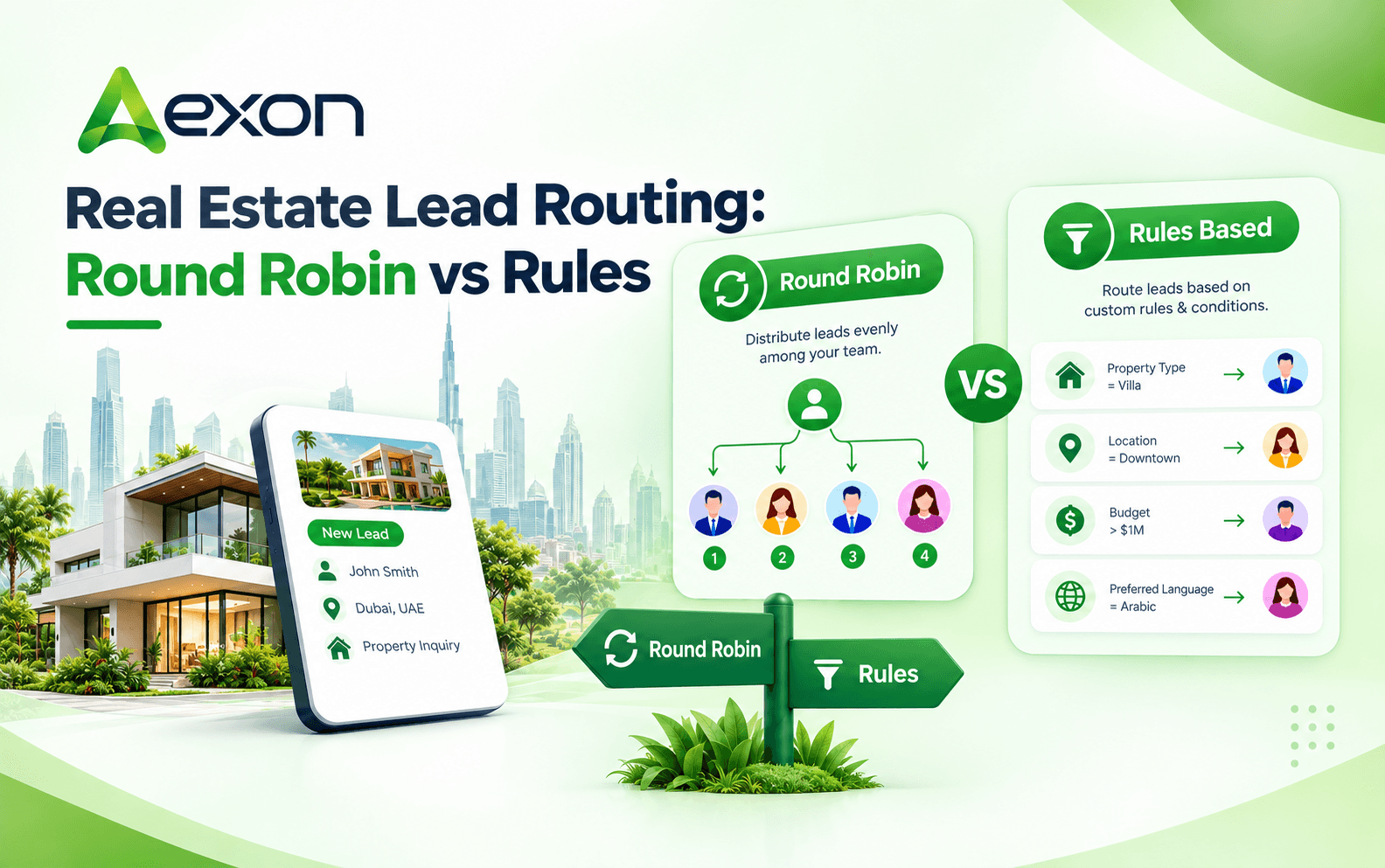
The real estate industry sources its leads from a variety of channels. Property websites, social media, paid advertisements, referral programs, and WhatsApp are some means that can attract potential clients such as buyers, tenants, landlords, and investors into the sales pipeline. With an increase in the number of leads, it becomes challenging to manually allocate them to the appropriate agents.
Lead routing can come to the aid in such cases. Lead routing enables a business to allocate its incoming leads to the appropriate agent or team automatically, thereby allowing the salesperson to respond promptly and own each of its leads.
There are two primary lead routing methods namely, round robin and rules-based lead routing. The former two have similarities but operate differently.
What Is Real Estate Lead Routing?
Real estate lead routing is a procedure where incoming leads for properties are automatically assigned to agents or teams based on set criteria.
If the inquiry about a certain property in Dubai comes in, for example, the CRM will automatically route it to a suitable agent who is available in Dubai. The inquiry doesn't have to be manually routed by the manager.
This depends on the CRM used but the criteria used in routing could include:
- Location of the property
- Type of the property
- Lead source
- Customer budget
- Language
- Agent availability
- Agent speciality
- Lead value
- Workload of the agent
The objective of this is to reduce delays and ensure that all leads get to the right salesperson in time.
What Is Round-Robin Lead Routing?
Round-robin routing involves sharing leads among agents on a rotating basis.
Let’s say there are four agents in the group; they would rotate in the following order:
Agent A → Agent B → Agent C → Agent D → Agent A
Whenever a new lead comes in, it will be assigned to the agent in the order above.
Example
Assume there is a brokerage firm where there are five salespeople working on similar residential properties. There are 15 new leads and the CRM system will share them among agents, assigning about three leads to each one.
Advantages of Round Robin
Easy to use: It is simple to comprehend and implement.
Equitable: The leads are evenly spread among the agents involved.
Quick: Leads can be distributed as soon as they come in without a manager's intervention.
Scalable: New agents can be added to the process as the team expands.
Disadvantages of Round Robin
The round-robin system does not guarantee that the agent is the right person for handling a certain lead.
For instance, a customer searching for commercial property will be given to an agent who deals with residential apartments primarily. This is equitable; however, it is not always the right choice.
The above weakness will be more significant as the business develops further and agents specialize in certain areas.
What is Rules-Based Lead Routing?
Rules-based lead routing means routing the inquiries on the basis of specific criteria.
Unlike randomly assigning the leads among agents, the system assesses some information regarding the lead and identifies the appropriate salesperson or sales team to whom the lead will be routed.
For instance:
- Dubai leads → Dubai team
- Abu Dhabi leads → Abu Dhabi team
- Commercial property → Commercial team
- Luxury properties → Luxury specialists
- Arabic-speaking leads → Arabic-speaking agents
- High-value inquiries → Senior sales team
This makes the routing process more targeted.
Example
Consider that an inquiry has been received by the prospect for a luxury villa located in Dubai within the budget of AED 5 million.
CRM can assess that:
Location: Dubai
Property: Luxury Villa
Budget: AED 5 million
With the help of specific rules, CRM can route the inquiry to the agent who is a specialist in Dubai luxury property.
There is no need for the prospect to wait for a manager to assign the appropriate salesperson.
Round Robin v/s Rules-Based Routing
This revolves around how each process assigns the responsibility of the lead.
Factor | Round Robin | Rule-Based |
Method | Sequential rotation | Defined rules |
Process Complexity | Easy | Complicated |
Allocation Process | Uniform allocation | Select Allocation |
Expertise of the agent | Less | High |
Geographical Routing | Few options | Available |
Properties Routing | Few options | Available |
Workload Management | Basic | Flexible |
Suitable for | Equally skilled | Specialized teams |
The round robin technique concentrates on fairness, whereas the rules-based technique concentrates on relevance.
Which Routing Technique is More Suitable for Real Estate?
It will depend on the organizational structure of the brokerage.
If it has a small number of agents who all deal with the same kind of properties, then the round robin technique might be more suitable.
If the brokerage is a large organization with various branches, departments, property types, and specialized agents, then rules-based technique would be better.
For instance, a company can create rules such as:
Dubai + apartment → Dubai residential team
Dubai + luxury villa → Luxury property team
Commercial inquiry → Commercial sales team
Abu Dhabi inquiry → Abu Dhabi team
It will ensure that the lead goes to a person who is knowledgeable and experienced in the matter.
Can Round Robin and Rules Be Used Together?
Yes, it is possible. On the contrary, the use of rules and round robin together will provide an effective approach for real estate lead routing.
With the help of rules, the appropriate team can be chosen, and with round robin method, the leads can be distributed evenly between agents of the chosen team.
For example, a new inquiry falls into:
Dubai → Residential → Apartment
CRM system at first routes the lead to the team of Dubai residences and then with round robin method assigns the inquiry to the next free agent.
In this case, specialization and even distribution of leads are reached.
It can be especially helpful in large brokerage firms.
Reasons Why WhatsApp Real Estate Lead Routing Is Necessary
WhatsApp is now becoming an integral communication tool for businesses in the real estate industry. Customers initiate conversations via ads, websites, QR code scanning, social media campaigns, and even direct WhatsApp messages.
Without a systematic approach, such conversations could be hard to handle.
Some of the issues involved include:
- Slow responses
- More than one agent reaching out to the same client
- Lack of clear lead ownership
- Lack of follow-ups
- Manually assigning the lead
- Losing track of the conversation
A WhatsApp CRM integrates incoming conversations from WhatsApp with customers' data and automatically routes them to the right salesperson.
In case a new customer initiates WhatsApp conversation, the system will create or update the customer record, find the source of the lead and their needs, apply the routing rules, and assign the conversation to the agent.
The assigned salesperson can now communicate with the customer, having all their data in one place.
How to Decide on Your Lead Routing System
Before you decide on a routing system, take into account the size of your sales team.
Use Round Robin If:
- Your agents sell similar property types
- You want straightforward automation
- Equal lead distribution is essential
- Your sales team is small or mid-sized
- Complex routing criteria are not required
Use Rule-Based Routing If:
- Your agents specialize in various property types
- You work in different geographical locations
- The type of property determines which agent is allocated the lead
- Language is an issue for the client
- High-value leads need to be assigned to senior agents
- You need complete control over your leads
Use Both When:
- You have specialized sales teams
- Balanced lead distribution among teams is needed
- There is a high number of leads
- Lead allocation is consuming a lot of time
Conclusion
Efficient lead routing for a real estate business can be highly advantageous in ensuring smooth management of new leads by a brokerage firm.
The round-robin method offers an easy way of distributing leads in a fair manner among agents, while the rules-based method helps in allocating leads based on geographical location, type of property, budget, language, or expertise of the agents.
In case of real estate companies that are growing, it would be beneficial to use a combination of the two methods. The rules can be used to determine the team of agents, whereas round robin can be used to allocate leads fairly in the particular team.
By integrating lead routing with the CRM and WhatsApp automation services, businesses can save time, respond faster, own leads and have a streamlined process for sales.
Contact Aexon at business@aexon.app or WhatsApp +91 81601 08049 to learn about how Aexon’s CRM and WhatsApp automation solutions can assist in your lead routing and follow-up process.
Real estate lead routing is a technique used to route the incoming inquiries to the right agent/team automatically based on the criteria like location, property type, source of the lead, budget, language, etc.
The round-robin routing distributes leads among different agents on a rotation basis. This method works well where all the agents have similar duties and the company would like to have an equal distribution of the leads.
Rules-based routing determines the agent/team based on the predefined conditions and routes the leads. These conditions may include location of the property, property type, budget of the customer, language of the customer, etc.
Round robin is good for equal and simple distribution of leads while rules-based routing can be used by companies who want to route their leads based on certain criteria. Many large brokerages use both methods.
Yes. The WhatsApp CRM software can help in capturing incoming chats and automatically routing to the agents through predefined rules or round robin distribution.