-1.png)
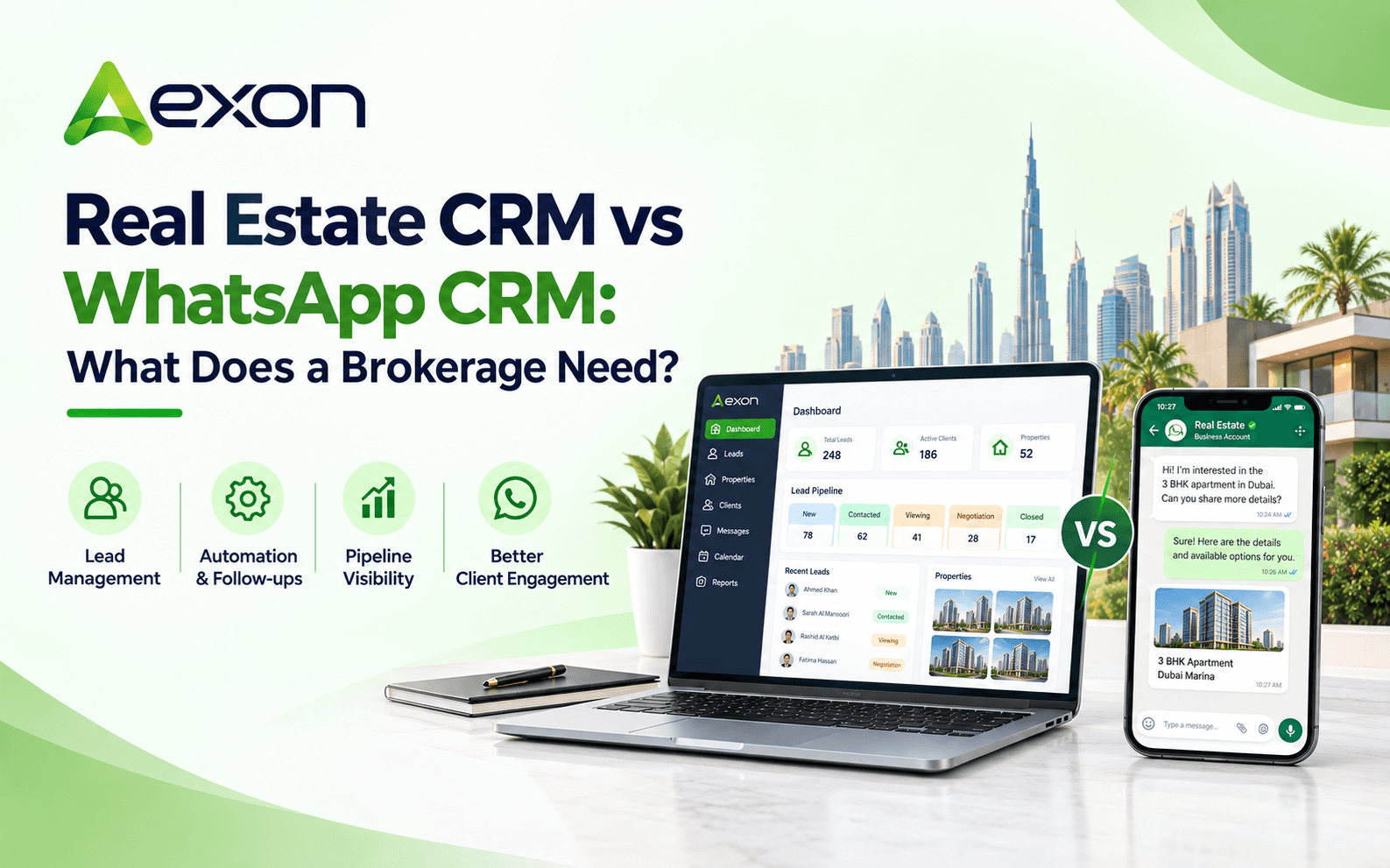
For successful real estate sales, fast replies, timely communication, and follow-up are essential elements. A potential client can contact a brokerage regarding the purchase of a property today, ask more details tomorrow, and schedule a viewing of the house in a few days' time. A delayed response can easily lose a deal to a competitor.
This is one of the reasons why selecting proper technology for today’s real estate business is critical.
When people think of such technology, two systems often come to mind: a real estate CRM and WhatsApp CRM. Both tools allow a company to organize their interactions with clients and work with leads, but they concentrate on various aspects of the process.
And so, real estate CRM vs WhatsApp CRM – what will a brokerage require?
What is Real Estate CRM?
Real estate CRM is an application that is used to bring together leads, contacts, properties, sales process, and client data.
A standard real estate CRM will assist an organization in:
- Lead generation and organization
- Lead allocation to sales persons
- Pipeline management
- Customer communication tracking
- Follow-ups scheduling
- Appointments scheduling
- Activity tracking
- Reporting
For instance, a brokerage firm will be able to track their leads through various stages like:
New Lead → Contacted → Qualified → Site Visit → Negotiation → Closed
It allows the managers to have an idea about the sales pipeline while giving the agents the next steps to take.
Traditional CRM will work best for brokerage firms handling large teams and many properties.
What Is a WhatsApp CRM?
WhatsApp CRM integrates customer conversations on WhatsApp into CRM and sales processes.
WhatsApp itself is an established form of communication for real estate firms. Sales agents utilize it to reply to inquiries, communicate property information, share photos and documents, schedule appointments and reach out to prospects.
WhatsApp CRM incorporates those conversations into an organized sales process.
This will depend on the specific platform used, but it allows for:
- Shared WhatsApp inbox
- Lead capture
- Automatic response
- Lead qualification
- Follow-ups automation
- Appointment reminders
- Assigning of an agent
- Conversation history
- CRM records
There is one important distinction to be made:
Real estate CRM manages the sales process, whereas WhatsApp CRM centers on customer communication.
Real Estate CRM vs WhatsApp CRM
The two platforms both have a number of key strengths.
Feature | Real Estate CRM | WhatsApp CRM |
Pipeline management | Good | Good |
Sales pipeline | Good | Available |
Property management | Good | Limited/varies |
WhatsApp conversations | Usually requires integration | Core feature |
Shared inbox | Depends on platform | Core feature |
WhatsApp automation | May require integration | Core feature |
Agent assignment | Yes | Yes |
Appointment management | Yes | Yes |
Reporting | Strong | Varies |
Conversation history | Depends on integration | Centralized |
The conventional real estate CRM is typically better suited for handling the entire business process and sales operations.
The WhatsApp CRM is especially valuable when WhatsApp is one of the primary means of reaching out to prospects.
Why WhatsApp Matters for Real Estate
Real estate customers often need multiple conversations before making a decision.
They may ask about:
- Price of the property
- Location
- Availability
- Facilities
- Methods of payment
- Pictures and videos
- Documents of property
- Times for site visit
Most of the time, these discussions take place on WhatsApp.
But the problem arises because these discussions are managed manually by individual agents. Essential information could be lost, follow-ups could be missed, and the manager may not know anything about the customer discussion at all.
Wholesale WhatsApp CRM will integrate these discussions into the lead management process.
The Problem With Using WhatsApp Alone
WhatsApp is a good tool for communication, but not intended to be used for managing a real estate sales pipeline on its own.
If real estate agencies deal with numerous inquiries and do that manually, they risk encountering issues like:
- Missed client communications
- Delayed follow-ups
- Scattered client data
- Uncertainty in lead ownership
- Limited visibility
- Complicated reports
For instance, if an agent gets a request regarding a property, but does not continue working with a client after an initial conversation, the agency will not know about the lost opportunity.
The Importance of Having a Shared WhatsApp Inbox
With a shared inbox, it will be possible for several authorized team members to handle customer interactions from one central business location.
It comes handy in situations whereby the customer interaction cannot be handled by one particular agent or when the interaction needs to be moved to another team member.
Rather than the customer interaction being limited in the personal account of one agent, the brokerage firm will have a better idea about which interactions are going on.
How does Automation Help Real Estate Teams?
Real estate teams have to engage in a lot of repetitive messaging.
For instance, following up after getting a new enquiry from a client, an agent could be required to:
- Acknowledge the enquiry.
- Find out what the customer wants.
- Offer him/her properties he/she might want.
- Check whether there was a reply.
- Book a viewing visit.
- Inform him/her about the visit.
- Follow up after the visit.
Automation can help minimize this effort on their part.
The brokerage firm can automate the lead qualification, follow ups, and appointments.
The Best Approach: CRM + WhatsApp
When it comes to choosing between real estate CRM and WhatsApp CRM, it is not just about picking one of the two.
What works best is combining the two of them.
An efficient workflow could involve:
Lead Source → CRM Record → WhatsApp Conversation → Lead Qualification → Agent Assignment → Follow-Up → Appointment → Sales Pipeline
Here is how customer interaction becomes tied to CRM data.
At Aexon, we take a WhatsApp first approach to CRM, assisting businesses in linking WhatsApp chats with CRM entries, lead management, automation, appointments, and customer communication.
It works particularly well with enquiries coming through websites, property portals, social media platforms, advertising etc.
What Should Brokers Look For in a Platform?
Before choosing a platform, brokers must consider their sales process.
1. Leads Management
It should allow managing, organizing, assigning, and tracking leads.
2. WhatsApp Integration
In case WhatsApp is widely used for communication, the CRM must have proper business WhatsApp integration.
3. Shared Inbox
The team members must be able to manage customer communication without relying on agents completely.
4. Automation
Look for auto replies, leads qualification, follow-ups, appointment reminders, and automation of the workflow.
5. Pipeline Management
The managers must be able to see the stage of each lead – whether it is a new, qualified, scheduled to visit, negotiating, or closed lead.
6. Reporting
Reports should give insights into leads, agents, follow-ups, appointments, and conversions.
Conclusion
A real estate CRM and a WhatsApp CRM are not necessarily competing systems as they address different aspects of the customer journey.
The former assists with leads, property management, sales pipeline management, agents, and reporting.
The latter assists with conversation management, follow-up tracking, automation, and WhatsApp integration for businesses.
Combining both capabilities can help build a more comprehensive sales pipeline for contemporary brokerages.
By recording all inquiries, connecting customer conversations to CRM entries, managing follow-ups, and knowing what next steps agents need to take, brokerages can avoid lost opportunities and build consistency.
For brokerages that use WhatsApp extensively, a WhatsApp-focused CRM system like Aexon will help integrate conversations with CRM workflow and automation.
For more information on Aexon's WhatsApp and CRM solutions, please contact Aexon Systems at business@aexon.app or WhatsApp +91 81601 08049.
No. Real estate CRM is more powerful when it comes to sales pipelines, property management, leads, and reports. WhatsApp CRM concentrates on customers' chats and WhatsApp automation.
WhatsApp CRM helps brokerages to centralize their communications, organize follow-ups, automate communications, and gain transparency throughout the sales team.
Yes. Depending on the platform, businesses are able to automate replies, qualification messages, follow-ups, appointment confirmations, and reminders.
It depends. Small teams will be fine with that. Larger companies will definitely benefit from the combination of WhatsApp communications and CRM.
Lead management, WhatsApp integration, shared inbox, automation, lead assignment, pipeline management, appointments, and scalability are some of the necessary ones.